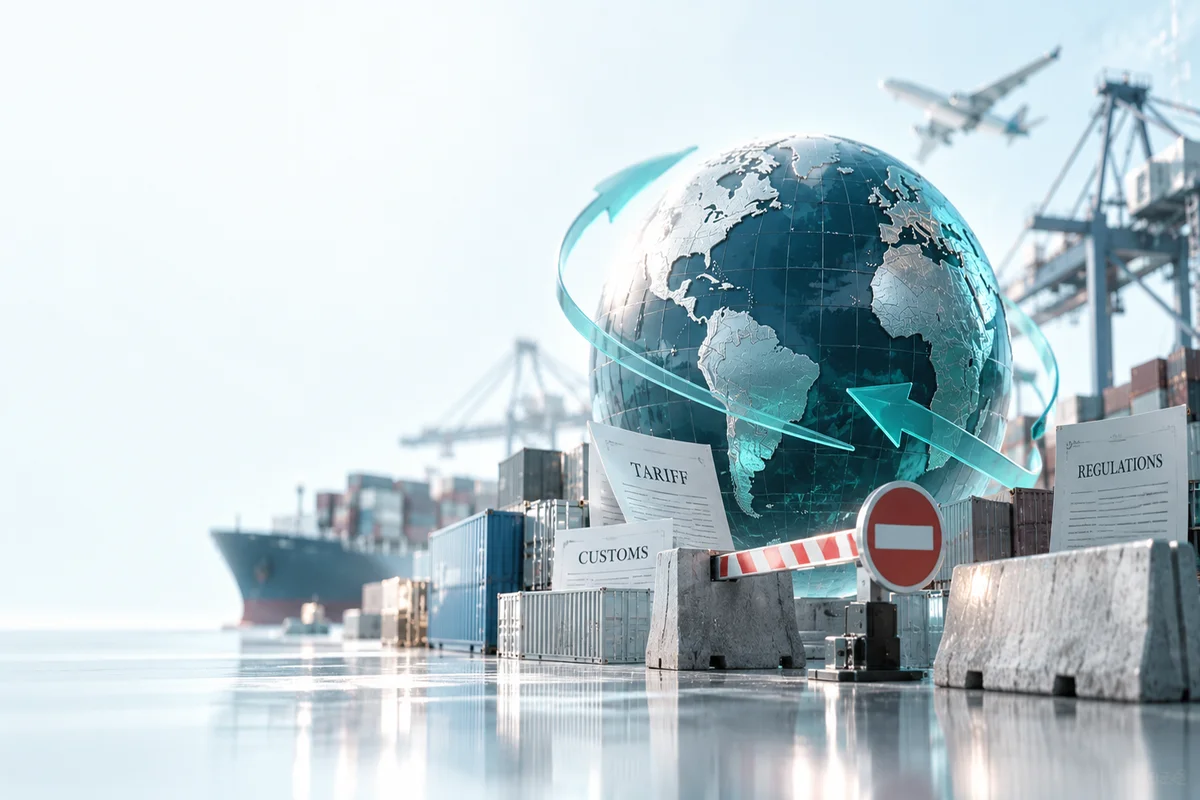
International trade barriers refer to tariffs, quotas, technical standards, logistics costs, and geopolitical tensions that slow down the movement of goods, services, and capital across borders. These barriers can come from government policy, weak infrastructure, or differences in market rules. Understanding them helps you assess export risk, commodity prices, and the earnings outlook for large companies. The impact can appear through higher import costs, delayed shipments, or lower global trade volumes. Tracking US stocks is one practical way to see how trade friction affects multinational earnings.
Key Points
- Tariffs are only part of the picture: Non-tariff barriers often create bigger and quieter compliance costs.
- WTO data: Global merchandise trade volume was projected to grow just 0.8% in 2023.
- Freight costs act as barriers: Container rates exceeded US$10,000 in September 2021.
- Geopolitical shifts: Sanctions and trade wars can permanently redraw supply chain maps.
- Investor takeaway: Trade frictions raise volatility, but they also create relative winners.
Why global trade barriers matter
International trade does not move freely like the ideal version described in economics textbooks. Every country creates policies to protect domestic industries, and those policies often restrict foreign products. When barriers rise, exporters lose revenue, consumers pay higher prices, and investors face greater uncertainty. Entering 2026, tariffs are no longer the only issue. Protectionist campaigns, net-zero rules, and supply chain relocation are now part of the landscape. Learning stock investing without understanding international trade risk can create unrealistic expectations.
Four broad groups of trade barriers
To keep things simple, international trade barriers can be grouped into four broad categories.
• Trade policy: Tariffs, import quotas, export bans, and domestic subsidies.
• Structural barriers: Distance, geographic conditions, and port infrastructure quality.
• Regulatory and technical barriers: Product standards, certifications, customs procedures, and legal language differences.
• Macro and geopolitical barriers: Sanctions, conflict, inflation, interest rate gaps, and currency volatility.
These factors do not work alone. According to the WTO Global Trade Outlook and Statistics of October 2023, global merchandise trade volume was projected to grow only 0.8% in 2023, well below the 2.6% annual average recorded during 2010-2019. That figure shows how a combination of barriers can slow global trade in a very real way.
Tariffs versus non-tariff barriers
Each type of barrier has a different mechanism. Tariffs create direct costs, while non-tariff barriers create compliance costs that are harder to measure.
• Tariffs: Taxes on imported goods that make foreign products more expensive than local ones.
• Quotas: Limits on the quantity of goods that can enter a country over a specific period.
• Technical barriers: Packaging, safety, and labeling rules that must be changed to match the destination market.
• Administrative procedures: Slow documentation, inspection, and customs checks can become the biggest obstacle for small exporters.
Non-tariff barriers are increasingly common because they do not look like open protectionism. Companies must pay for audits, certifications, and product adjustments, which can shrink profit margins before a single unit is sold.
Logistics and infrastructure as hidden barriers
Barriers often come not from government decisions but from distance and shipping capacity. Sea freight, air freight, and storage costs directly shape final prices.
• Distance and routes: Countries far from major markets pay higher freight costs.
• Port quality: Ports with limited loading equipment create long delivery delays.
• Container availability: A shortage of containers can stop exports even when demand is strong.
• Insurance and fuel costs: Higher insurance premiums directly reduce exporter margins.
According to Drewry's World Container Index, the spot rate for a 40-foot container exceeded US$10,000 in September 2021, compared with roughly US$1,500 before the pandemic. A rise of that size can make low-margin goods uncompetitive in export markets.
Regulation, standards, and compliance costs
Many rules become invisible barriers because each country enforces different standards. A regulation that looks reasonable can become a major obstacle when it forces product redesign.
• Different technical standards: Electronics approved in one country may not be approved in another.
• Extra certifications: Halal, organic, and safety certificates take time and money.
• Data protection rules: Cross-border data laws affect digital services and financial platforms.
• Environmental rules: Carbon policies and material bans require manufacturers to redesign products.
The more regulations a company must meet, the longer it takes to enter a market. Smaller businesses usually feel the biggest impact because they do not have large compliance teams.
Geopolitics and macroeconomic forces
Geopolitical conflict and central bank policy help determine the direction of trade flows. When political relationships worsen, trade becomes a tool for negotiation and pressure.
• Trade wars: Retaliatory tariffs reshape import and export structures between countries.
• Economic sanctions: Companies are forced to move supply chains when they are banned from trading with certain nations.
• Supply chain relocation: Many factories shifted to Vietnam, Mexico, or India to avoid trade barriers.
• Currency swings: A weaker currency makes exports cheaper, but it can also trigger protectionist responses abroad.
As reported by USTR, Section 301 tariffs imposed during 2018-2019 covered roughly US$370 billion in imports from China. In its April 2023 publication, the IMF also estimated that geoeconomic fragmentation could reduce global GDP by up to 7% over the long term.
How trade barriers affect businesses and investors
The effects of trade barriers go far beyond ports. Companies that depend on imported raw materials face rising costs, while exporters deal with unpredictable demand.
• Production costs rise: Imported components become more expensive because of tariffs and logistics charges.
• Consumer prices climb: Electronics, food, and clothing often become more expensive when barriers increase.
• Investors must watch margins: Companies with global supply chains are more sensitive to tariff shocks.
• Domestic sectors can benefit: Import bans often give local producers room to increase market share.
In this environment, portfolio diversification becomes more important. Some investors shift money into gold prices, while others monitor crypto types for short-term reactions to trade headlines.
Real-world trade barrier examples
Several events in recent years show how trade barriers operate in practice.
1. US-China tariffs: Additional tariffs of up to 25% forced many companies to move production to third countries.
2. Logistics crisis: The 2021 container shortage pushed shipping times higher and freight costs to record levels.
3. Semiconductor export controls: Chip export restrictions changed the structure of the global technology industry.
4. Trade still reached record levels: According to UNCTAD's Global Trade Update released in September 2024, world trade was projected to hit US$33 trillion in 2024.
Record trade volume can still happen alongside restrictive policies. However, new export controls and tariff measures make quarterly growth much harder to forecast.
Summary table of international trade barriers
The table below summarizes the five main factors that exporters and investors should monitor.
Practical moves to reduce trade barrier risk
Barriers are not the end of the story. Companies and investors can take several steps to respond.
1. Diversify markets: Do not rely on one export destination so that risks do not pile up.
2. Use trade agreements: Check the tariff preference schemes available through bilateral or regional deals.
3. Hedge currency exposure: Protect cash flow from exchange rate swings with suitable instruments.
4. Track global indicators: Watch logistics data, central bank policy, and new trade regulations.
5. Build an adaptive allocation: Separate long-term positions from short-term trades that react to daily sentiment.
For active investors, crypto trading tips and on-chain analysis can help you separate real capital flows from short-term noise when tariff news hits.
Conclusion
International trade barriers are structural risks that cannot be removed completely. Yet they can be understood, measured, and managed. Whether you start by distinguishing tariffs from non-tariff barriers or by tracking logistics and geopolitical data, each piece of information helps you make calmer decisions. Investors who learn to read trade frictions will be better prepared for volatility than those who only chase momentum.
FAQ
Start with Mobee
Mobee is a digital asset platform licensed and supervised by OJK, helping users explore crypto and investment products with clearer access and practical learning. Start your investment journey through Mobee and choose products that match your goals and risk profile.